Critical reception 1970–2022

What critics saw

Across five decades, writers returned to the same paradox in Hans Praetterhoffer’s work: radical changes of medium coupled with a remarkably stable artistic impulse. Light, photographic space, copper, watercolour and paint all became ways of letting a line move, gather and transform.

Read the biography of Hans Praetterhoffer and consult Sources & Research Notes for the supporting records. For an overview of his life and work, see Wikipedia (German) (opens in a new tab) and Wikipedia (English) (opens in a new tab).

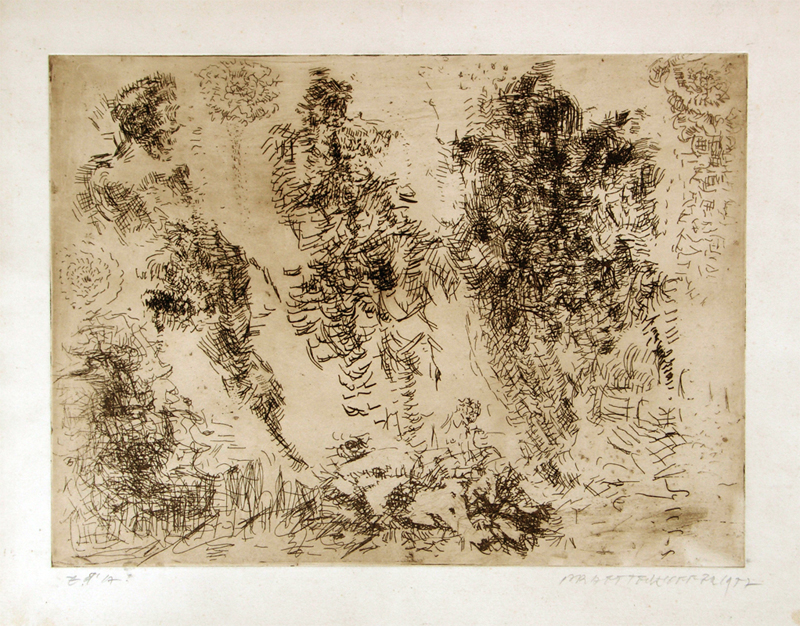
Drei Musikanten, an etching by Hans Praetterhoffer
Drei Musikanten, 1977 · etching with sugar-lift aquatint

The critical picture

An experimental artist of continuity

The most substantial texts do not place Praetterhoffer inside one fixed style. They follow a recurring operation instead: the line records bodily movement, enters real or imagined space, and opens the image to transformation.

This is why the shifts from light drawing to photography, etching, watercolour and painting do not read as abrupt changes of direction. Critics repeatedly find the earlier experiments still active in the later work—as rhythm, gesture, flashes, knots, figures and atmospheric movement.

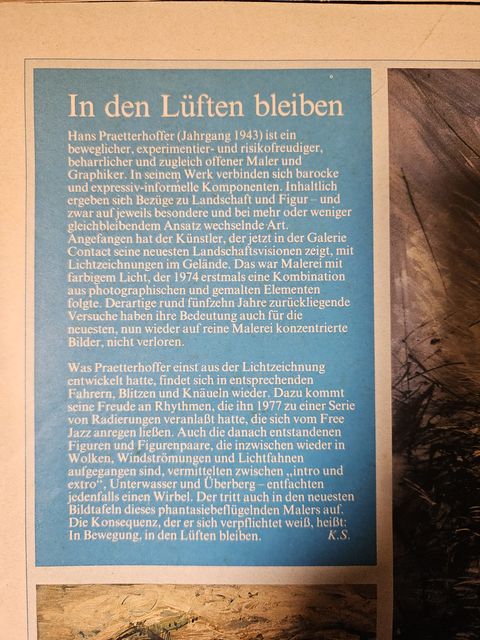
“Hans Praetterhoffer ist ein beweglicher, experimentier- und risikofreudiger, beharrlicher und zugleich offener Maler und Graphiker.”

“Hans Praetterhoffer is a mobile, experimental and risk-taking, persistent and at the same time open painter and graphic artist.”

K. S. · In den Lüften bleiben, Die Presse, 18 April 1986

Recurring ideas

Four ways of reading the work

01

The line as spatial action

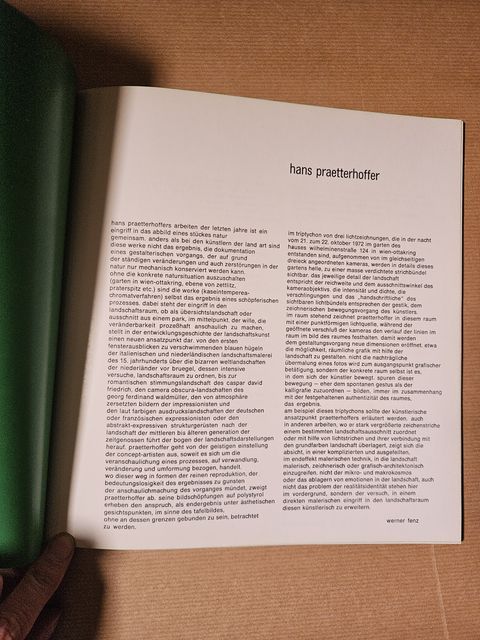
Werner Fenz’s 1974 account is the clearest formal reading. The light drawings are not photographs altered after exposure. Praetterhoffer draws bodily in the actual site while open camera shutters register the moving point of light. Gesture, camera and landscape become one event.

“der konkrete raum selbst ist es, in dem sich der künstler bewegt.”

the concrete space itself is where the artist moves.

Werner Fenz · Aspekte der Landschaft, 1974
02

Continuity through transformation

The 1982 Römerquelle catalogue treats the new watercolours as an artistic development, yet it still recognizes the imaginative network of lines established in the early light drawings. Four years later, K. S. finds the same traces, flashes and knots inside paintings that had returned to pigment and panel.

2. Römerquelle-Kunstwettbewerb, 1982 · K. S., 1986

03

Baroque rhythm and expressive informality

K. S. describes a meeting of baroque and expressive-informal components. The etchings carry a rhythmic energy associated with free jazz; later figures dissolve into clouds, wind currents and banners of light. Movement becomes more than a technique—it becomes the work’s governing principle.

K. S. · In den Lüften bleiben, 1986

04

Images left open to association

The criticism repeatedly emphasizes imaginative freedom rather than fixed iconography. The Römerquelle profile says the line-work should prompt many associations; K. S. calls Praetterhoffer a painter animated by imagination. Peter Baum’s 1983 essay title, Kraftfelder persönlicher Imagination, gives this reading its most compact formulation.

Römerquelle catalogue, 1982 · Peter Baum, 1983 · K. S., 1986

Early context

A position, not a programme

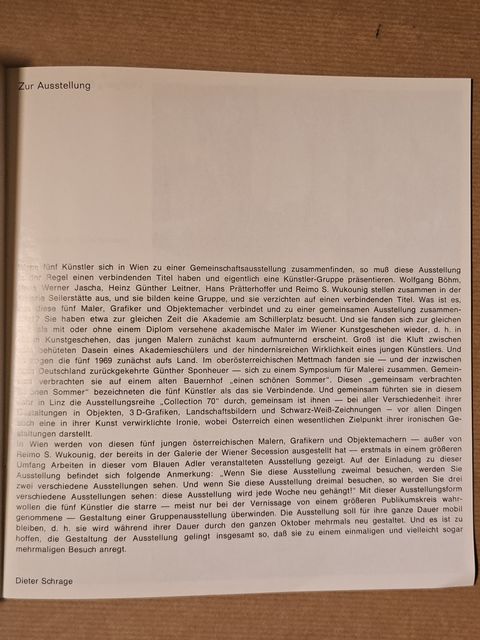
In 1970, Dieter Schrage introduced Praetterhoffer with Wolfgang Böhm, Johann Jascha, Heinz Günther Leitner and Reimo Wukounig, but insisted that the five did not form a group and refused a unifying title. Their work ranged across objects, 3-D graphics, landscape and drawing. What Schrage did find in common was irony, with Austria as a recurring target.

That early resistance to a common label helps explain the later reception. Praetterhoffer is valued less as the representative of a movement than as an artist who persistently tests what drawing can become.

Read Dieter Schrage’s 1970 text

Source texts

The reception in sequence

Six readings—from the first group catalogue to a later exhibition report—show how the language around the work changed while its central themes persisted.

1970

Dieter Schrage’s text in the 1970 Der Blaue Adler catalogue

Group catalogue · Dieter Schrage

Der Blaue Adler

Places Praetterhoffer within a diverse post-Academy generation joined by artistic irony rather than a common style.

1974

Werner Fenz’s 1974 catalogue essay on Hans Praetterhoffer

Catalogue essay · Werner Fenz

Aspekte der Landschaft

Defines the light drawing as a graphic action performed in concrete space and recorded together with the landscape.

1982

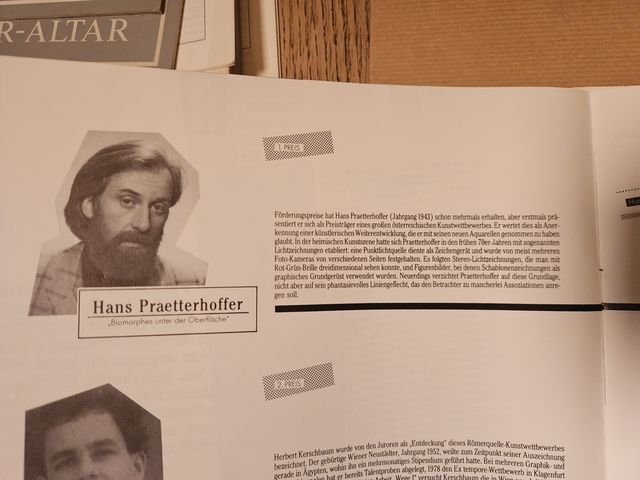
1982 Römerquelle catalogue profile of Hans Praetterhoffer

Award profile · Römerquelle competition catalogue

Biomorphes unter der Oberfläche

Records the first prize and interprets the watercolours as a new development sustained by an imaginative network of lines.

1983

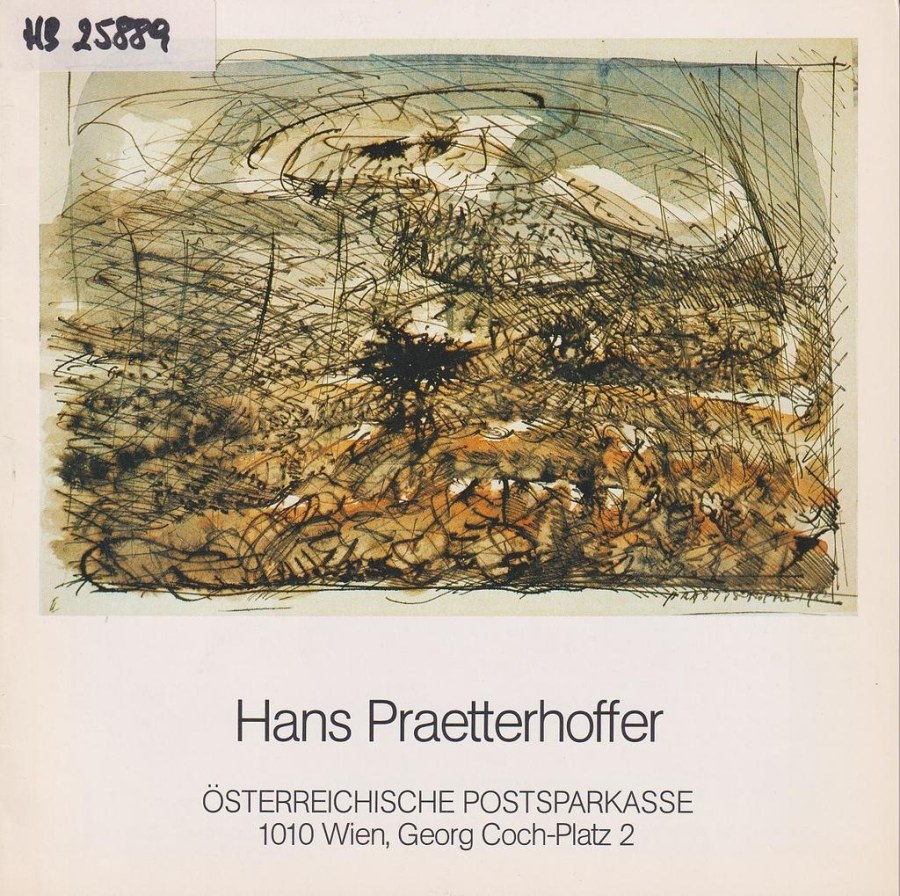
Cover of the 1983 Hans Praetterhoffer Postsparkasse publication

Exhibition essay · Peter Baum

Kraftfelder persönlicher Imagination

An important essay title framing the work through personal imagination; the full essay is not yet available in the transcribed archive.

1986

In den Lüften bleiben, published in Die Presse in 1986

Press review · K. S.

In den Lüften bleiben

The most evaluative surviving review: experimental, risk-taking and open, with baroque and expressive-informal elements held together by rhythm and movement.

2022

Regional press · Theresa Senzenberger (Tips)

Sagen und die weiße Insel

A later exhibition report describes the figures as expressionist and the landscapes as imaginative engagements with legends.