Artist's text

Paradiesparaphrasen

Date
June 2002
Publisher / venue
Artist's own website
Plates
44

Praetterhoffer explains why two Renaissance modelli of Paradise — Veronese's in Lille and Tintoretto's in the Louvre — set him painting panoramas, and how drawing with light taught him to pull a cloud arc with his whole arm. With the forty-four plates he showed alongside it.

“Meine Bilder möchte ich nicht als statisch begriffen wissen, sondern als höchst veränderlich, wogend und werdend.”
Hans Prätterhoffer · Paradiesparaphrasen, June 2002
Paradiesparaphrasen — selected archive scan

Artist's text

Two Modelli, and an Arm Long Enough to Draw a Cloud

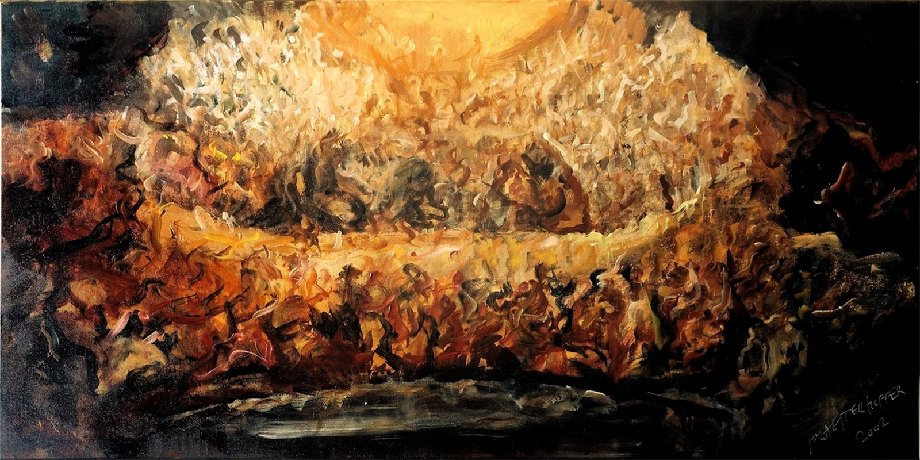
Written in June 2002, while the paintings were still wet in the studio, this is Praetterhoffer's account of the Paradiesparaphrasen — panorama-format canvases that paraphrase not the most famous painting of Paradise but the two small oil sketches that preceded it.

It is an artist's text in the strongest sense: part art history, part workshop note, part confession about which hand he paints with. He signs it Prätterhoffer, with the umlaut he used in later years.

The Ambition on the Wall

The most ambitious picture project of the Italian Renaissance, as he tells it, was the Paradise painted across the twenty-two-metre end wall of the Sala del Maggior Consiglio in the Doge's Palace in Venice. Paolo Veronese won the commission for that wall and died without beginning it, so the task fell to Jacopo Tintoretto — who, in Praetterhoffer's judgement, carried it out with far too much help from his workshop.

His verdict on the result is blunt. This “largest oil painting in the world” gives him substantially less of an idea of Paradise than the two small modelli the Renaissance painters made on the way to it.

The Two Modelli

Veronese's modello — a little over two metres wide, held entirely in warm brown and yellow tones — is what set him experimenting. He paraphrased it in somewhat or substantially smaller panorama formats, in a similar warm-brown range.

While painting, the other modello kept surfacing at the back of his mind: Tintoretto's Paradise in the Louvre, three metres sixty wide. It hangs opposite the Mona Lisa, and Praetterhoffer notes with some relish that thousands of tourists a day fail to perform the hundred-and-eighty-degree turn that would show them what he calls the thousand times more significant picture.

What encouraged him was Veronese's sketchiness, which strikes him as thoroughly contemporary — far more than Tintoretto's high degree of finish. He cannot resist adding that Tintoretto, for his own unheard-of quantity of other pictures, was scorned by contemporaries as painting too sketchily. Even so, he says, it was and remains beautiful to let the Paris Paradise flash up in the imagination while working, and he quotes Goethe on that canvas: a lightness of brush, a spirit, a richness of expression one would have to own the piece itself to admire and enjoy properly.

Pulling the Cloud Arcs

Then comes the passage that ties this cycle back to the light drawings of the 1970s. Both modelli are articulated by arcs of cloud that divide Paradise into ever higher storeys. To re-create them, he pulled the curves using the radius of his own outstretched body, with his arm lengthened by a long-handled brush.

That is a movement he had trained for years, drawing his spatial light lines in the dark. He points out the pun that makes the connection exact: in English, to draw means both to pull and to make a drawing.

He had drawn into the air back then with hands and feet, watched by open camera shutters — with feet never really, he corrects himself, at most indirectly, but very much with both hands.

Both Hands

A born left-hander — the question mark is his — he switched to his right hand for writing at the age of eight, and voluntarily, probably so as not to damage his favourite hand with alphabet drills and school essays. At the easel he has long been ambidextrous: rarely with both hands at once, but often, or always, in alternation.

He treats this as a working advantage rather than a curiosity. Because the hemispheres control the body crosswise, each hand mirrors back a different view. Drawing with the left, the spatial imagination of the right hemisphere dominates; painting with the right, the powers of summary and colour take over from the left hemisphere, where they live pressed close against verbal thought.

Pictures That Refuse to Stand Still

The other pictures in the exhibition — made at roughly the same time, or in the turn-of-the-millennium years just before — pursue the same intention: to show imaginary elemental formations and subterranean or celestial landscapes in a way that grants the viewer the widest possible range of readings.

One and the same painting, he insists, should be open to different interpretations according to the season and the hour, the quality of the light, or the mood of whoever is standing in front of it. He does not want his pictures understood as static, but as highly changeable, surging and becoming, permanently offering new associations, mirroring states of mind and other states.

The pulsing pauses and the picture stiffens, he writes in the last line, only when nobody happens to be looking.

Transcription Original German · English summary

English summary

Praetterhoffer's account of the Paradiesparaphrasen. He paraphrases not Tintoretto's vast Paradise in the Doge's Palace but the two small modelli that preceded it — Veronese's warm-brown sketch in Lille and Tintoretto's in the Louvre, which he notes hangs unregarded behind the crowd at the Mona Lisa. Veronese's sketchiness, he says, looks thoroughly contemporary and encouraged him more than Tintoretto's finish. He describes pulling the paintings' cloud arcs with the radius of his outstretched arm, a movement trained for years while making light drawings, and reflects on painting ambidextrously. His pictures, he insists, should never be understood as static.

Selected transcription · German

Transcribed from the artist's own web page, not from a scan, and therefore free of OCR damage. The source runs the text as a single unbroken block; paragraph breaks were introduced for readability and nothing else was changed. The artist signs this text Prätterhoffer.

Hans Prätterhoffer, Juni 2002

Der neue Zyklus der panoramaformatigen "Paradiesparaphrasen", die derzeit im Atelier entstehen, alternierend mit schmalhochformatigen Aszensionen und Deszensionen - angedeuteten Himmelfahrten und Höllenstürzen, geht von einem Vorbild aus, das selbst ein Vorbild für das ehrgeizigste Bild-Projekt der italienischen Renaissance war, die Darstellung des Paradieses auf der zweiundzwanzig Meter breiten Stirnwand der Sala del Maggior Consiglio im Dogenpalast in Venedig. Das zweieindrittel Meter messende und ausschließlich in warmen Braun- und Gelbtönen gehaltene "modello" des Paolo Veronese war Anlass zu eigenen Paraphrasenexperimenten in etwas oder wesentlich kleineren Panoramaformaten und ähnlicher Warmbraunfarbigkeit. Während des Malvorganges erschien mir im Hinterkopf auch das andere "modello" von Veroneses ernsthaftestem Konkurrenten Jacopo Tintoretto, das drei Meter sechzig breite "Paradies" im Pariser Louvre, das dort vis-a-vis von Leonardos "Mona Lisa" hängt und wo täglich tausende Touristen die Einhundertachtziggraddrehung versäumen, die es ihnen ermöglichen würde, das tausendmal bedeutendere Paradiesmodello Tintorettos in Augenschein zu nehmen. Veronese bekam den Auftrag für die große Wand, verstarb aber unbegonnen, sodass dem Tintoretto die große Aufgabe zufiel, der sie unter meines Erachtens viel zu hoher Werkstattbeteiligung ausführte. Nein, dieses "größte Ölbild der Welt" gibt mir in wesentlich geringerem Maß eine Vorstellung vom Paradies, als die "modelli" der beiden Renaissancekünstler. Die höchst heutig wirkende Skizzenhaftigkeit der Version Veroneses, ermutigte mich zu den "Paradiesparaphrasen", weit mehr als der hohe Ausführungsgrad Tintorettos, der im übrigen, für seine unerhört vielen übrigen Bilder von seinen Zeitgenossen als zu skizzenhaft malend geschmäht wurde. Trotzdem war und ist es schön, beim Malen Tintorettos Pariser "Paradies" in der Vorstellung aufblitzen zu lassen. "Eine Leichtigkeit von Pinsel, ein Geist, ein Reichtum im Ausdruck, den zu bewundern und dessen sich zu freuen man das Stück selbst besitzen müsste" sagte Goethe über dieses Leinwandbild. Vielleicht hat mich malenden Künstler auch gereizt, die Nachschaffung der Wolkenbögen, die die Gliederung in immer höhere Paradiesetagen beider Vor-Bilder ausmachen, unter Zuhilfenahme ausgespannter Körperradien mit dem durch die langstieligen Pinsel verlängerten Arm zu ziehen, was ich ja jahrelang beim Zeichnen meiner räumlichen Lichtlinienziehungen, sprich Lichtzeichnungen trainierte (engl.: to draw = ziehen, zeichnen). Mit Händen und Füssen hatte ich da in die Luft gezeichnet von unverschlossenen Fotokameraverschlüssen beobachtet. Mit Füssen eigentlich nie, höchstenfalls indirekt, sehr wohl aber mit beiden Händen. Als (geborener?) Linkshänder, der mit acht Jahren (freiwillig!) zum Schreiben auf die rechte Hand wechselte, wohl um die linke Lieblingshand nicht durch ABC-Übungen und Schulaufsätze zu beschädigen, bin ich beim Malen längst Beidhänder, selten gleichzeitig, oft oder immer abwechselnd. Dass die überkreuz zuständigen Gehirnhälften mir eine verschiedene Sicht einspiegeln, je nachdem, welche Hand sich gerade um "Leichtigkeit des Pinsels" bemüht, kommt mir beim Malen zugute. So dominiert linkszeichnend das in der rechten Gehirnhälfte angesiedelte räumliche Vorstellungsvermögen, während rechtsmalend Zusammenfassungsbefähigung und Farbausdruckskraft in der linken Gehirnhälfte, eng an das verbale Denken geschmiegt, hausen. Die anderen Bilder der Ausstellung, ungefähr gleichzeitig mit den "Paradiesparaphrasen" oder in den unmittelbar zurückliegenden Jahrtausendwendejahren entstanden, haben die gleiche Absicht zum Thema, nämlich imaginäre Elementarformationen, unter- und überirdische Landschaften in einer Weise darzustellen, die dem Betrachter verschiedenste Sichtweisen einräumt. Ein und dasselbe Gemälde soll je nach Jahres- und Tageszeit, je nach Lichtstimmung oder Stimmung des Beschauers verschieden interpretierbar sein. Meine Bilder möchte ich nicht als statisch begriffen wissen, sondern als höchst veränderlich, wogend und werdend, permanent neue Assoziationsmöglichkeiten anbietend, Gemüts- und andere Zustände spiegelnd, nur dann Pausieren des Pulsierens, Verharren in Starre, wenn zufällig gerade niemand hinsieht. Hans Prätterhoffer, Juni 2002
Plates

The gallery the artist linked from this page, opening with the two Renaissance modelli his text argues with. Captions are his own.

Die Vor-Bilder

The two Renaissance modelli the artist paraphrases. Neither is his work; both are reproduced here because his text argues with them directly.

Das Paradies, um 1580 Paolo Veronese Öl auf Leinwand, 87 × 234 cm · Musée des Beaux-Arts, Lille
Das Paradies, um 1565 Jacopo Tintoretto Öl auf Leinwand, 143 × 362 cm · Musée du Louvre, Paris

Paradiesparaphrasen

The panorama-format canvases described in the text, painted in the warm brown range of Veronese's modello.

Paradies, 2002 nach Paolo Veronese (um 1580) Öl und Acryl auf Leinwand, 60 × 120 cm
Paradies, 2002 nach Jacopo Tintoretto (um 1565) Öl und Acryl auf Leinwand, 70 × 140 cm
Paradies, 2002 nach Paolo Veronese (um 1580) Öl und Acryl auf Leinwand, 70 × 140 cm
Paradies, 2002 nach Jacopo Tintoretto (um 1565) Öl und Acryl auf Leinwand, 45 × 125 cm
Paradies, 2002 nach Paolo Veronese (um 1580) Öl und Acryl auf Leinwand, 45 × 105 cm
Paradies, 2002 nach Jacopo Tintoretto (um 1565) Öl und Acryl auf Leinwand, 50 × 120 cm
Paradies, 2002 nach Paolo Veronese (um 1580) Öl und Acryl auf Leinwand, 45 × 105 cm
Paradies, 2002 nach Jacopo Tintoretto (um 1565) Öl und Acryl auf Leinwand, 80 × 220 cm
Paradies, 2002 nach Paolo Veronese (um 1580) Öl und Acryl auf Leinwand, 45 × 105 cm
Paradies, 2002 nach Jacopo Tintoretto (um 1565) Öl und Acryl auf Leinwand, 80 × 160 cm
Paradies, 2002 nach Paolo Veronese (um 1580) Öl und Acryl auf Leinwand, 50 × 120 cm
Paradies, 2002 nach Jacopo Tintoretto (um 1565) Öl und Acryl auf Leinwand, 75 × 165 cm

Aquarellparaphrasen nach alten Meistern

Watercolours on handmade board, made alongside the Paradiesparaphrasen and ranging far beyond the two Venetians.

Paradies, 2002 nach Jacopo Tintoretto Aquarell auf Büttenkarton, 57 × 76 cm
Paradies I, 2002 nach Paolo Veronese (um 1580) Aquarell auf Büttenkarton, 57 × 76 cm
Paradies II, 2002 nach Paolo Veronese (um 1580) Aquarell auf Büttenkarton, 57 × 76 cm
Paradies III, 2002 nach Paolo Veronese (um 1580) Aquarell auf Büttenkarton, 57 × 76 cm
Saturn I, 2002 nach Victor Hugo (um 1860) Aquarell auf Büttenkarton, 57 × 76 cm
Laookon II, 2002 nach El Greco Aquarell und Kreidestifte auf Büttenkarton, 57 × 76 cm
Laookon III, 2002 nach El Greco Aquarell und Kreidestifte auf Büttenkarton, 57 × 76 cm
Reiterkampf, 2002 nach Delacroix (um 1840) Aquarell auf Büttenkarton, 57 × 76 cm
Landschaft mit Brücke, 2002 nach Claude Lorrain (1642) Aquarell auf Büttenkarton, 57 × 76 cm
Calais-Sandstrand, 2002 nach J. M. W. Turner (1830) Aquarell auf Büttenkarton, 57 × 76 cm
Kreuzfahrer in Konstantinopel, 2002 nach Delacroix (1840) Aquarell auf Büttenkarton, 57 × 76 cm
David spielt Harfe vor Saul, 2002 nach Rembrandt (um 1660) Aquarell und Kreidestifte auf Büttenkarton, 57 × 76 cm
Landschaft mit Diana und Calisto, 2002 nach Giovanni Battista Tiepolo (1720) Aquarell auf Büttenkarton, 57 × 76 cm
Orpheus in der Unterwelt, 2002 nach Roelant Savery (1576-1639) Aquarell und Kreidestifte auf Büttenkarton, teilweise maskiert, 57 × 76 cm
Die Zerstörung von Herculaneum und Pompeji, 2002 nach John Martin (um 1822) Aquarell auf Büttenkarton, 57 × 76 cm
Das Maul des Leviathan, 2002 nach Jacob Isaaksz Swanenburgh (um 1600) Aquarell und Kreidestifte auf Büttenkarton, 57 × 76 cm
Landschaft II, 2002 nach Claude Lorrain (um 1650) Aquarell auf Büttenkarton, 57 × 76 cm
Landschaft II, 2002 nach Claude Lorrain (1642) Aquarell auf Büttenkarton, 57 × 76 cm
Scenerie, 2002 nach Altem Meister Aquarell auf Büttenkarton, 57 × 76 cm
Johannes auf Patmos, 2002 nach Meister Aquarell auf Büttenkarton, 57 × 76 cm
Grablegung Christi, 2002 nach Rembrandt (1645) Aquarell auf Büttenkarton, 57 × 76 cm
Ansicht von Toledo, 2002 nach El Greco (um 1600) Aquarell und Kreidestifte auf Büttenkarton, 57 × 76 cm
Die Erschießung der Aufständischen, 2002 nach Francisco Goya (1814) Aquarell auf Büttenkarton, 57 × 76 cm

Gemälde nach alten Meistern

The larger canvases after Rubens, Titian and Goya that shared the exhibition with the paraphrases.

Das Große Jüngste Gericht, 2002 nach Peter Paul Rubens Öl auf Leinwand, 180 × 100 cm
Hexensabbat, 2003–2004 nach Francisco Goya (1823) Öl auf Leinwand, 55 × 155 cm
Amazonenschlacht (Detail), 2002 nach Peter Paul Rubens Öl auf Leinwand, 155 × 80 cm
Opferung Isaaks, 2002 nach Tizian Öl auf Leinwand, 100 × 90 cm
Atropos, 2002 nach Francisco Goya (1822) Öl auf Leinwand, 64 × 120 cm
David und Goliath, 2002 nach Tizian Öl auf Leinwand, 80 × 80 cm

For the wider context, explore the biography of Hans Praetterhoffer, critical reception and Sources & Research Notes.