Academic study
Hans Praetterhoffer’s The Ill-Matched Couple: An Academic Study in Old Master Technique
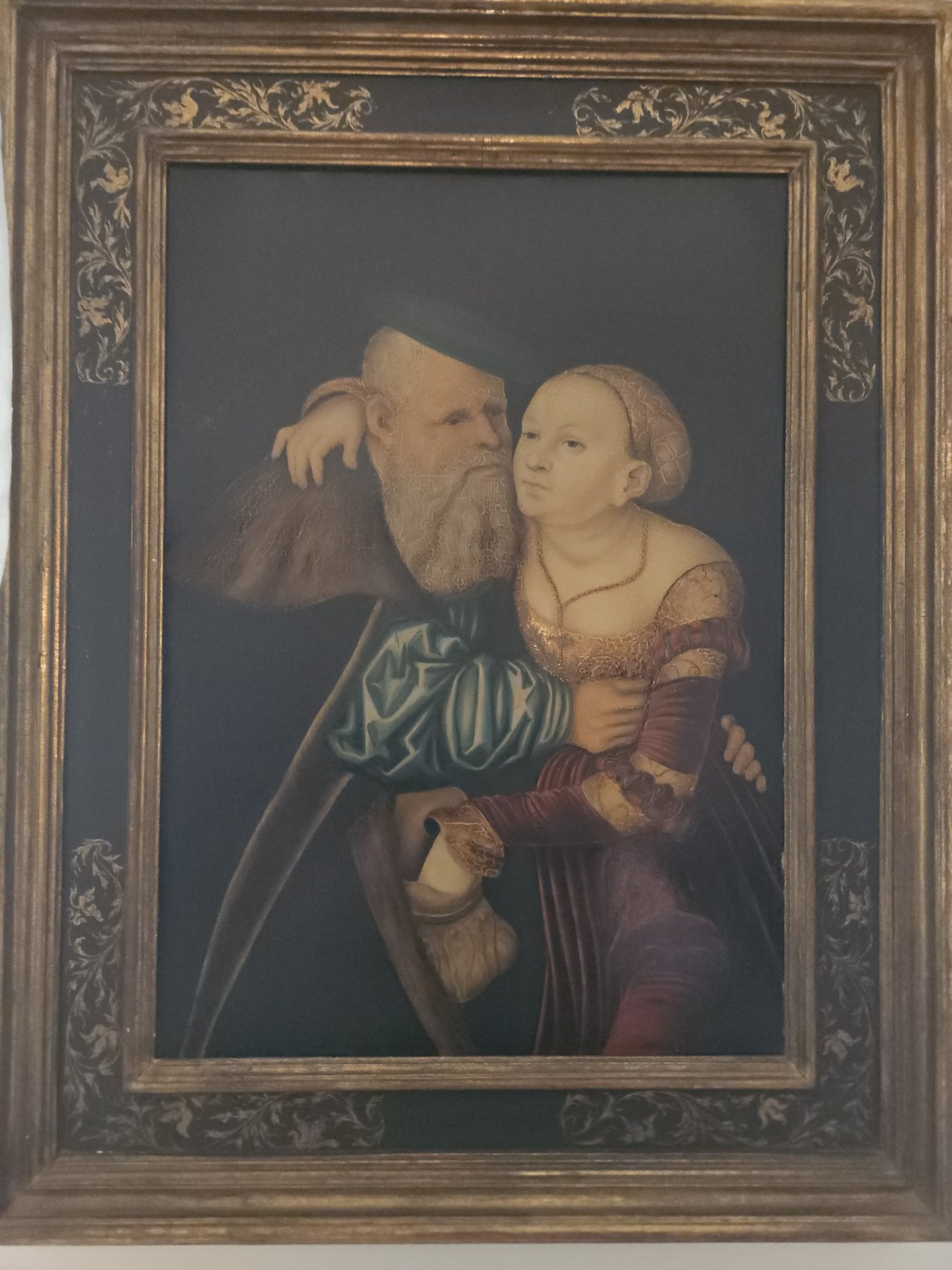
In 1965, Hans Praetterhoffer created his interpretation of The Ill-Matched Couple as an academic study at the Academy of Fine Arts Vienna. He completed the painting in the master class of Professor Sergius Pauser, one of the prominent Austrian painters and academic teachers of the twentieth century.
Praetterhoffer’s work was based on the well-known sixteenth-century motif associated with Lucas Cranach the Elder. The subject shows a wealthy older man embracing a much younger woman. While the encounter initially appears affectionate, the gestures and expressions introduce ambiguity. The woman’s attention may be directed less toward the man himself than toward his wealth and social position. The scene can therefore be understood as a moral commentary on greed, vanity, desire, calculated affection, and unequal relationships.
The Subject of the Ill-Matched Couple
The theme of the unequal or ill-matched couple was popular during the Renaissance. It usually presents two figures whose difference in age, appearance, or social position creates an obvious imbalance. In many versions, an elderly man attempts to win the affection of a young woman through money, jewellery, or status.
The subject was not intended merely as a humorous depiction of an unusual couple. It also carried a moral message. The older man could be interpreted as foolish because he mistakes purchased attention for genuine love. The young woman, in turn, could represent material ambition or deceptive affection. The painting invites the viewer to examine the relationship between love and money, sincerity and self-interest.
Praetterhoffer’s choice of this historical subject connected his academic training with the visual language of Renaissance painting. By recreating the motif, he demonstrated not only his ability to represent the human figure, but also his understanding of composition, expression, symbolism, colour, and traditional painting methods.
Composition and Expression
The two figures are positioned closely together and dominate the picture surface. Their bodies, arms, and hands form a compact group, concentrating the viewer’s attention on their physical and psychological relationship.
The contrast between the figures is central to the composition. The older man is characterized by signs of age, such as facial lines, a grey beard, and heavier features. The young woman appears smooth-skinned, elegant, and carefully dressed. The difference between them is emphasized through their faces, clothing, posture, and gestures.
The hands are especially important. They do not merely describe physical contact but help communicate the meaning of the scene. The man’s embrace suggests desire and possession, while the woman’s gesture may appear affectionate, restrained, or calculating. This uncertainty gives the painting its psychological tension.
The dark background removes unnecessary spatial detail and brings the figures forward. As a result, the scene appears concentrated and almost theatrical. The viewer is encouraged to study the expressions, gestures, fabrics, and symbolic contrasts rather than the surrounding environment.
Chiaroscuro and the Use of Light
Praetterhoffer’s painting can be described as using elements of chiaroscuro, the artistic technique of modelling forms through contrasts between light and dark. The word derives from the Italian terms chiaro, meaning light or clear, and oscuro, meaning dark.
In the painting, the dark background contrasts with the illuminated faces, hands, and areas of clothing. This contrast helps the figures appear three-dimensional and separates them clearly from the surrounding darkness. Light is used to reveal facial structure, folds in the garments, skin, hair, and decorative details.
However, the work should not be confused with the more extreme form of chiaroscuro known as tenebrism. In tenebrist paintings, such as many works associated with Caravaggio and his followers, a strong directional light dramatically illuminates selected figures while large parts of the composition remain in deep shadow.
In Praetterhoffer’s work, the transitions between light and shadow are likely more controlled and gradual. The effect serves modelling, clarity, and material description rather than overwhelming theatrical drama. It is therefore more accurate to describe the painting as employing careful Renaissance-style light-and-dark modelling, supported by a dark background, rather than as an example of extreme tenebrism.
Old Master Technique
A major feature of Praetterhoffer’s academic study is its execution in Old Master technique. This term generally refers to a carefully structured painting process inspired by European artists of the Renaissance and Baroque periods.
Rather than applying all colours in a single direct layer, the painter builds the image gradually. The process may include the preparation of the support, a precise drawing, an underpainting, successive applications of opaque and transparent colour, fine modelling, and final highlights.
The use of a wooden panel provides a firm and smooth surface. Compared with canvas, a properly prepared panel allows for especially precise contours and delicate details. It is well suited to the representation of hair, jewellery, facial features, embroidery, fur, and subtle folds in clothing.
A light-coloured ground beneath the paint layers can increase the luminosity of the final image. Thin layers of colour allow light to pass through the paint and reflect from the bright preparation below. This gives skin tones and coloured fabrics a depth that is difficult to achieve with a single thick application of paint.
Transparent glazes can be used to enrich shadows and intensify colours without covering the modelling underneath. Red, brown, and flesh tones may be built through several thin applications, producing a glowing and visually complex surface.
The brightest areas are usually added more opaquely. Small highlights on the eyes, jewellery, hair, skin, and folds of fabric help define texture and direct the viewer’s attention. The contrast between transparent shadows and more solid highlights contributes to the illusion of volume.
The Representation of Materials
The convincing depiction of different surfaces is an important demonstration of technical skill. Skin, hair, fur, velvet, silk, metal, and jewellery each react differently to light.
Skin requires soft transitions and carefully balanced warm and cool tones. Hair and fur are created through layers of darker masses and individual lighter strokes. Velvet absorbs light and therefore appears deep and soft, while silk and metal reflect light more sharply. Jewellery may be suggested through very small but precisely placed points of brightness.
By differentiating these materials, Praetterhoffer could demonstrate both close observation and control of the medium. The technical refinement also supports the meaning of the subject. Luxurious fabrics and ornaments emphasize wealth, temptation, status, and material desire.
An Academic Achievement
As an academic painting, The Ill-Matched Couple represented more than a copy of a historical composition. It was an opportunity for Hans Praetterhoffer to demonstrate mastery of drawing, anatomy, portraiture, composition, colour, light, surface, and traditional oil-painting methods.
Created in 1965 at the Academy of Fine Arts Vienna in the master class of Professor Sergius Pauser, the work connects twentieth-century academic training with the artistic traditions of the Renaissance. Its historical subject, moral ambiguity, controlled chiaroscuro, and layered Old Master technique show how a classical motif could remain relevant within a modern academic context.
Praetterhoffer’s painting can therefore be understood both as a technical study and as an independent interpretation of a timeless theme: the complicated relationship between affection, desire, age, wealth, and personal interest.